
June 2011
Issue #27
Contents
News and Announcements: Information on happenings, including newly released databases and products
Recent Publications: A sample of materials, including peer-reviewed journal articles, utilizing HCUP data
Users´ Tech Tip: Answers to commonly asked questions when working with HCUP data
HCUP Calendar: Upcoming conferences or meetings at which HCUP will be represented
Miss the last e-News? Read it on the HCUP-US Website
The 2009 NIS Now Available!
The 2009 Nationwide Inpatient Sample (NIS) has just been released. The NIS is the largest inpatient care database in the U.S. and includes all patients, regardless of payer – covering Medicare, Medicaid, privately insured, and uninsured patients.
The 2009 NIS contains data from approximately 8 million hospital stays, drawn from more than 1,000 community hospitals in 44 states. NIS data can be weighted to produce national estimates, allowing researchers and policy makers to identify, track, and analyze national trends in healthcare utilization, access, charges, quality, and outcomes.
The 2009 NIS is available for purchase through the HCUP Central Distributor, and data can be accessed via HCUPnet. Additional information on the NIS is available on the HCUP-US Website.
Coming this Summer: the 2009 KID
The highly-anticipated 2009 Kids’ Inpatient Database (KID) is scheduled to be released later this month. The KID is the only dataset in the U.S. designed specifically to study hospital use, outcomes, and costs in the pediatric (under age 21) population.
The KID will contain data from nearly 3.5 million pediatric hospital stays, drawn from over 4,000 community hospitals in 44 states. The KID includes all patients, regardless of payer – covering Medicare, Medicaid, privately insured, and the uninsured.
Once released, the 2009 KID can be purchased through the HCUP Central Distributor, and data will be available on HCUPnet. Additional information on the KID is available on the HCUP-US Website.
Currently-Available 2009 State Databases
HCUP’s 2009 state-level databases are released on a monthly basis, as they are completed. Researchers and policymakers can use these databases to investigate questions unique to one state; compare data from two or more states; conduct market area research; and identify state–specific trends in utilization, access, quality, charges, and outcomes.
The following 2009 HCUP state databases are currently available:
Available databases are listed on the HCUP Database and Product Release Calendar and in the SID/SASD/SEDD Application Kit. Databases can be purchased through the HCUP Central Distributor, and aggregated statistics for selected states can be accessed via HCUPnet.
For purchasing questions, please contact the HCUP Central Distributor.
Now Accepting Nominations for HCUP’s Outstanding Article of the Year Award
Nominations are now being accepted for HCUP’s Outstanding Article of the Year Award, which will recognize up to two researchers published in peer-reviewed journals in 2010 who used HCUP databases to explore and address healthcare research topics and issues.
Researchers may self-nominate or be nominated by another individual (e.g., a colleague). The chosen recipients will receive plaques and present posters of their work during the September 19-21, 2011 AHRQ Annual Meeting, at the Bethesda North Marriott Hotel & Conference Center  in Bethesda, Maryland. Transportation and accommodations for the event will be provided.
The nomination period closes on Friday, July 15, 2011, at 11:59 P.M. EDT. For complete information, please visit the HCUP-US Website at http://www.hcup-us.ahrq.gov/news/awards.jsp. For questions, please contact HCUP@ahrq.gov..
CCS-Services and Procedures Now Available for Fiscal Year 2011
The Clinical Classifications Software (CCS) for Services and Procedures has been released for Fiscal Year 2011. These files can be used with HCUP and other administrative healthcare databases.
The CCS-Services and Procedures handles more than 9,000 CPT codes and 6,000 HCPCS codes and collapses them into 244 clinically meaningful procedure categories that may be more useful for presenting descriptive statistics than individual codes. The CCS-Services and Procedures can be used for a variety of research purposes, including identifying populations for procedure-specific studies or developing statistical reports providing information (such as charges and length of stay) about groups of procedures.
For more information, please visit the Tools and Software page on the HCUP-US Website.
New Offerings from the HCUP Online Tutorial Series
AHRQ is pleased to announce the release of a new module and an updated re-release of a favorite in the HCUP Online Tutorial Series. These online trainings are designed to provide data users with information about HCUP data and tools, as well as training on technical methods for conducting research using HCUP datasets.
The HCUP Online Tutorial Series is available on the HCUP-US Website.
State Snapshots for the 2010 NHQR Now Available
The State Snapshots for the 2010 National Healthcare Quality Report (NHQR) was released May 31, 2011. The State Snapshots summarize healthcare quality by state along several dimensions of healthcare: overall, by type of care, setting of care, clinical area, clinical preventive services, and by special focus areas including disparities (race/ethnicity and community income) and payer. The
State Snapshots Website pulls together State-level information from the NHQR and displays it graphically.
HCUP is one source of data for the State Snapshots. A new feature of the State Snapshots this year is a compilation of online resources to assist states in taking action to improve healthcare quality and reduce disparities.
For more information on the NHQR and the State Snapshots, please visit the AHRQ’s
Measuring Healthcare Quality webpage.
New HCUP Methods Series Report Available on HCUP-US Website
AHRQ recently released a new HCUP Methods Series Report entitled Methodological Issues when Studying Readmissions and Revisits Using Hospital Administrative Data (Methods Report #2011-01).This report is intended to aid users of the HCUP Supplemental Variables for Revisit Analyses, as well as others using hospital administrative data for analyses of revisits (including readmissions). The report discusses the decisions that need to be addressed as an analyst designs a study of patients with sequential acute care hospital visits including considerations in preparing the administrative database for the analysis, defining repeat hospital visits, and reporting results. Using State Inpatient Databases (SID), State Ambulatory Surgery Databases (SASD), and State Emergency Department Databases (SEDD), the report provides specific examples of the implications of methodological decisions. It also examines variations in readmission study designs through a review of journal publications from the last decade.
All HCUP Method Series Reports can be found on the HCUP-US Website.
New HCUP Statistical Briefs Available on the HCUP-US Website
HCUP Statistical Briefs are short, focused reports on topics related to specific conditions, procedures, or populations.
Recently-released Statistical Briefs include:
These and other HCUP Statistical Briefs can be found on the HCUP-US Website.
HCUP Webinar Training Series and HCUP Data Users’ Workshop a Success
AHRQ recently hosted two 1-hour Webinars on HCUP databases, products and tools. The April 27 Webinar, Overview of the HCUP Databases, introduced health services and policy researchers to the HCUP databases and related resources. The May 4 Webinar, Overview of the HCUP Products and Tools, provided information on HCUP tools, supplemental files and publications, and demonstrated HCUPnet, our free online data query system.
On May 11, AHRQ sponsored a one-day, intermediate-level HCUP workshop at its headquarters in Rockville, MD. This workshop taught health services researchers and analysts how to use or improve their use of HCUP databases and products.
HCUP anticipates hosting additional Webinars and in-house trainings later this year. Announcements will be posted in the Events calendar on the HCUP-US Website.
Keeping Up with HCUP: Recent Events
Since the end of March, HCUP staff has participated in a number of events, including:
in Tampa, FL (ISPOR) 16th Annual International Meeting in Baltimore, MD 2011 Annual Meeting in Boston, MA
A complete list of HCUP events is available on the HCUP Events Calendar. We have a number of events coming up this summer, and we enjoy meeting HCUP users at our trainings, presentations, and exhibit booths. If you are in attendance, please stop by and say hello!
Eslami MH, McPhee JT, Simons JP, Schanzer AS, Messina LM. National Trends in utilization and postprocedure outcomes for carotid artery revascularization 2005 to 2007. J Vasc. Surg. 2011 Feb;53(2):307-22.
This study uses hospital discharge data from the 2005-2006 Nationwide Inpatient Sample (NIS) and Elixhauser Comorbidity Software files to provide an overview of trends in utilization, mortality, and stroke after carotid angioplasty and stenting (CAS) and carotid endarterectomy (CEA) at the national level. The article abstract is available via Pubmed.
Moy E, Barrett M, Ho K. Potentially Preventable Hospitalizations – United States, 2004-2007 MMWR Surveillance Summ. 2011 Jan;14(60):80-83.
This study uses AHQR Patient Quality Indicators (PQIs) and comes from the National Healthcare Disparities Report (NHDR) to estimate preventable hospitalizations and potential cost savings by income groups and by race/ethnicity in the United States. The article abstract is available via Pubmed.
To read additional recently-published articles featuring HCUP data, please visit the Research Spotlights page on the HCUP-US Website.
Impact of an Increasing Number of Diagnoses Reported in HCUP’s State Inpatient Databases (SID)
On an inpatient discharge record, the principal diagnosis is the condition established after discharge to be chiefly responsible for the patient’s admission to the hospital. Secondary diagnoses are associated conditions that coexist at the time of admission or that develop during the stay.
If a researcher using the HCUP State Inpatient Databases (SID) wants to consider the patient’s comorbidities or complications in their analysis, then the number of secondary diagnoses available in a record is important. The maximum number of diagnoses (element DXn) that can be reported on an inpatient discharge varies by HCUP State and data year. It is important to note that even if the SID allows for the reporting of a certain number of diagnoses, not all positions within that element will necessarily be filled with diagnostic information on an individual record. For example, the SID may have room for 15 diagnoses to be reported, but an individual discharge record in the SID may have only 4 or 5 diagnoses coded.
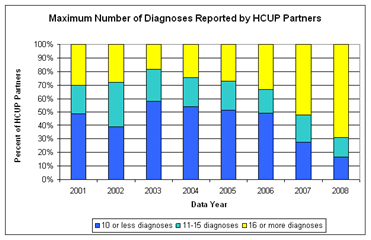
Over time, HCUP has seen an increase in the number of diagnoses reported in an individual record. In the 2001 SID, about half of the HCUP States included no more than 9 secondary diagnoses (or 10 diagnoses in total, including the principal diagnosis), and thirty percent of the HCUP states reported 16 or more diagnoses. After the 2006 SID, however, HCUP has seen a significant increase in the number of HCUP States that report 16 or more diagnoses: about 50 percent in 2007 and nearly 70 percent in 2008.
So what does this mean to researchers? The change in the number of available diagnoses will impact trend analyses that utilize information from the secondary diagnoses because the chance that the information will be captured increases with the number of available secondary diagnoses. Over time, researchers may see a trend in certain diagnoses increasing or potentially new diagnoses being associated other conditions.
For all of your HCUP-related questions, please contact User Support at hcup@ahrq.gov.
June 12-14, 2011: AcademyHealth 2011 Annual Research Meeting
HCUP chaired a panel presentation entitled "HCUP Data and Tools for Research" on June 12 from 11:00 A.M.-12:30 P.M. and participated in a Podium Presentation entitled Measuring Overuse, Overtreatment, and Inefficiency on June 14 from 11:30 A.M.-1:00 P.M. during the AcademyHealth 2011 Annual Research Meeting at the Washington Convention Center. Three posters were also presented on June 12-13, and an exhibit booth was staffed throughout the conference. Additional conference information is located on the AcademyHealth website.
June 12-16, 2011: Council of State and Territorial Epidemiologists (CSTE) 2011 Annual Conference
HCUP representatives staffed an exhibit booth during the 2011 CSTE Annual Conference at the 2011 CSTE Annual Conference at the David L. Lawrence Convention Center. Additional conference information is located on the CSTE website.
July 11-13, 2011: The International Health Economics Associations (iHEA) Transforming Health & Economics: 8th World Congress on Health Economics
HCUP representatives will provide a presentation entitled "Explanatory Tests of Geographic Variation in Healthcare Expenses and Efficiency" during iHEA’s 8th World Congress on Health Economics at the Sheraton Centre Toronto. An exhibit booth will also be staffed throughout the conference. Additional conference information is located on the iHEA website.
August 8-11, 2011: National Conference of State Legislatures (NCSL) Legislative Summit
HCUP representatives will staff an exhibit booth during the 2011 NCSL Legislative Summit at the Henry B. Gonzalez Convention Center. Additional conference information is located on the NCSL website.
For a complete list of HCUP presentations and events, visit the HCUP Events Calendar, located on the HCUP-US Website.
******************************************************
This publication and previous editions of HCUP e-News are available online at the HCUP-US Website.
HCUP e-News is distributed via the HCUP Mailing List.
For more information, or if you have any questions regarding HCUP e-News, please contact P. Hannah Davis, M.S., at hannah.davis@ahrq.hhs.gov